What does the new Planning Act and Natural Environment Act mean?
The Planning Act and Natural Environment Act replace the Resource Management Act (RMA), our main environmental and land-use law, with two separate Acts. Both Acts received Royal Assent in September 2026, meaning they formally became law, and transitional consenting began the following month. For Auckland developers, investors, and property owners, existing RMA plans and council consent processes still apply while the new system rolls out in stages.
This is the key features of the new system:
- The Planning Act governs land use, urban development, and subdivision.
- The Natural Environment Act manages the use, protection, and enhancement of natural resources.
- Modified RMA rules remain the main operating law during a multi-year transition while the Council create a new spatial plan and updates (or replaces) the Auckland Unitary Plan.
- Existing resource consents remain valid during the transition and generally carry over as equivalent permissions on the same conditions once the new system operates.
Why this reform matters for Auckland projects
Government officials estimate that around 45% of currently required consent and permit applications could be removed under the new system. Under the new system, some residential development may proceed without consent where it meets the relevant rules and standards. However, existing RMA processes continue during the transition. Whether your project needs consent still depends on current Auckland Unitary Plan rules and site standards.
The reform aims to settle major growth and environmental questions earlier through national direction and regional planning. Settling these questions upfront reduces repeated consent battles for individual builds. In our experience, clearer upfront standards help landowners budget and design with greater certainty.

How the two new Acts split planning rules
Parliament replaced the single RMA with two focused laws to separate development rules from environmental limits. The Planning Act 2026 sets the framework for land use, urban development, and subdivision. The Natural Environment Act 2026 governs the use, protection, and enhancement of natural resources like water, air, and ecosystems.
Under the new framework, 17 regional combined plans will eventually replace existing council planning documents nationwide. The consolidation is intended to simplify planning and will reduce the number of planning documents used nationwide. The system also introduces stronger national standards, narrower consent assessments, and a more permissive starting point for subdivision.
The new system introduces regional spatial plans with a planning horizon of more than 30 years. In Urban Planning Consultants’ earlier perspective on RMA reform, we advocated nationally drafted zones and funded infrastructure plans. That historical commentary predates the new Acts, which also add targeted regulatory relief and clearer dispute-resolution pathways.
What remains unclear at this stage is how conflicts between the objectives of the Planning Act and the Natural Environment Act are to be resolved. This will need clear guidance within the national policy statements to avoid the problems of the RMA with matters relitigated time and time again through consenting processes.
What changes now during the transition
The RMA remains the primary law for Auckland projects during the transition period which is expected to last as long as four years - through to 2030. Royal Assent occurred on 30 September 2026. Transitional consenting rules then took effect on 30 October.
Current Auckland Unitary Plan rules still govern most resource consent applications today. For some district land-use applications, targeted amendments already exclude specified residential matters such as internal layout, balconies, glazing and unit size from assessment. Private-property views and trade-competition effects are also excluded. Auckland Council has helpfully marked up their plan showing which rules now no longer have practical effect. An example is shown below:
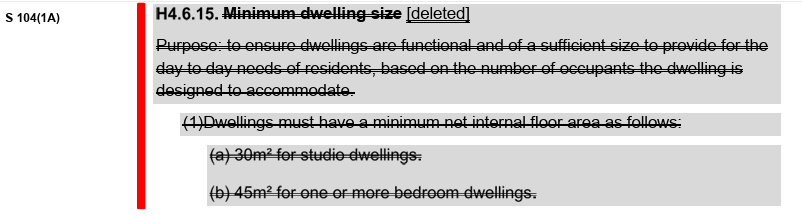
While the rules have been simplified, developers still need to do the usual checks around infrastructure capacity and hazards to ensure that consent is not needed for other reasons other than those set out in zoning provisions.
The dated roadmap to 2030
The transition to the new planning system is staged, with full-system operation intended by 2030. Councils and central government must build new national directions and regional plans before old RMA rules retire. According to the official implementation milestones, key stages run across the coming years:
- September 2027: The first national policy direction is due.
- June 2028: Draft regional spatial plans must be released for public feedback.
- December 2029: Proposed land use and natural environment plans are scheduled for notification.
- 2030: New resource consent and permit applications move fully under the new Acts.
The Government projects $13.3 billion in long-term administrative and compliance savings once the full system operates. These are broad national forecasts, so individual project costs will still vary. Auckland projects may still incur council processing fees, specialist report costs and infrastructure contributions.

What should Auckland project owners do now?
Smart planning starts with assessing your site under the rules in force today. Waiting for future law changes can stall feasible builds and expose budgets to rising construction costs.
Consider a townhouse developer in Albany. Seeking early planning advice before commissioning architectural drawings can reduce the risk of costly redesigns. Owners should not assume that future exemptions remove current Auckland Unitary Plan triggers. Always verify hazard overlays and infrastructure capacity before locking in your design.
We recommend these practical steps for Auckland property owners right now:
- Assess any current proposal under the Auckland Unitary Plan rules active at lodgement.
- Seek guidance on rules that may now be "out of scope" under section 104(1A).
- Check existing resource consents for lapse dates, conditions, and variation needs.
- Track Auckland Council work on the regional spatial plan and replacement Unitary Plan.
- Make early submissions when draft spatial and land-use plans open for public consultation.
- Seek site-specific planning advice before assuming your project will become consent-free.
Common questions
Do I still need a resource consent in Auckland right now?
Yes, existing Auckland Unitary Plan triggers still determine whether your project needs consent today. Current plan controls continue operating during the transition. However, targeted RMA amendments already affect some district land-use applications, including specified residential design matters, private-property views and trade-competition effects.
What happens to my existing resource consent when the new Acts take over?
Existing RMA consents generally carry over as equivalent permissions under the new legislation on the same conditions. You can keep building under an active consent provided you meet your lapse dates and compliance terms.
When will the replacement Auckland Unitary Plan rules apply?
New consent applications move fully under the new Acts in 2030. Draft regional spatial plans open for feedback in June 2028. Proposed land-use plans then follow in December 2029.
Planning your next Auckland project with confidence
With 18 years of experience in Auckland planning, our team guides landowners through Assessments of Effects, land use and subdivision consents, and regional permits. We also handle certificates of compliance, existing use rights, section 127 condition changes (consent variations), submissions, and plan-change advice. Contact us for site-specific Auckland town planning and resource consent advice to review your proposal, existing consent, or transition strategy.